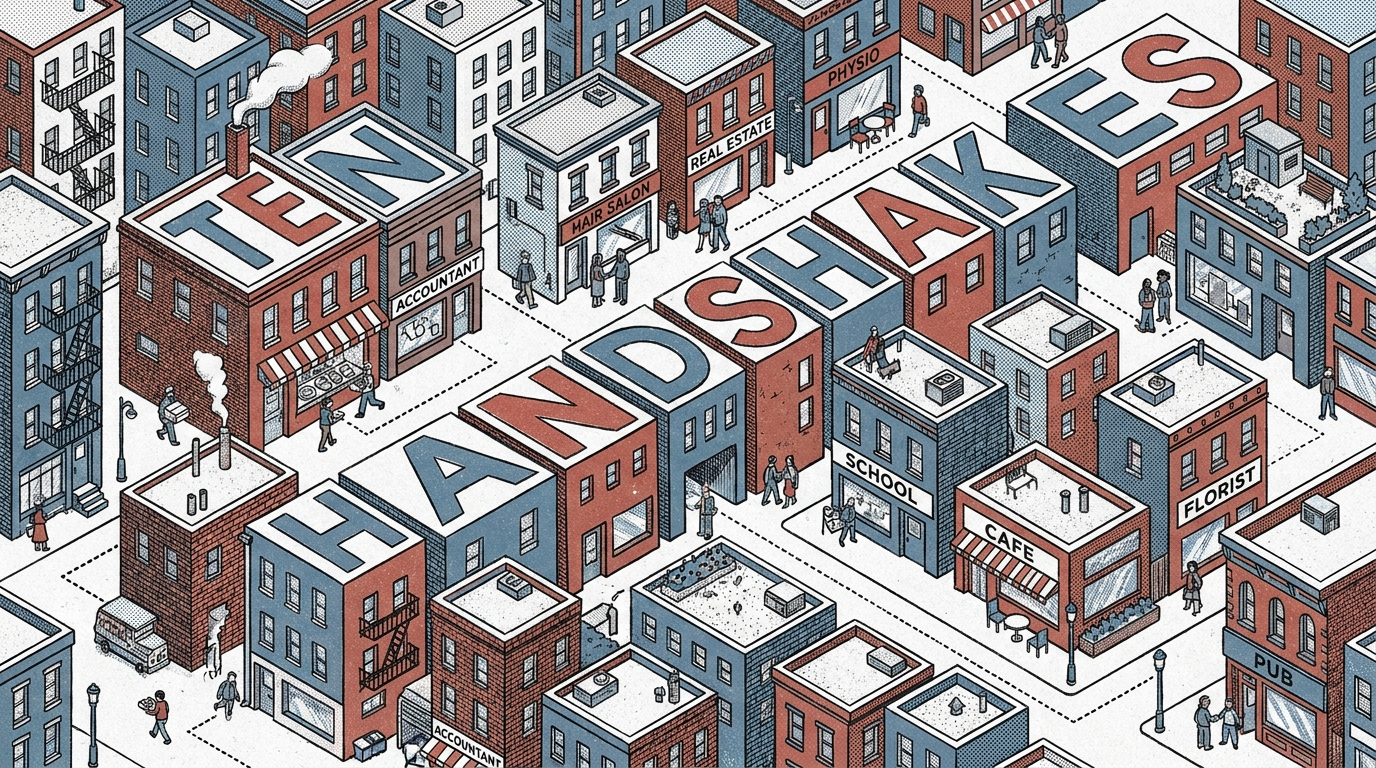
Ten Handshakes
Why the simplest growth strategy is the one nobody does
There's a bakery near my place that's been there about fifteen years.
Good product. Solid reputation. The kind of spot where you drive past on a Saturday and there's always a queue out the door. They've never run a paid ad. No Instagram strategy. No loyalty app. They just make really good bread and they've been doing it long enough that everyone within three suburbs knows about them.
But here's the thing. For the first five years, nobody knew they existed.
The owner told me once that the business nearly didn't survive year two. Revenue was flat. The product was already good. Same sourdough, same pastries, same early mornings. What changed wasn't the bread. It was that one week, out of pure frustration, he decided to take a stack of croissants and walk up the street.
He didn't have a plan. He didn't have business cards. He literally just knocked on doors. The accountant's office three doors down. The hair salon on the corner. The real estate agent with the big glass shopfront. He'd walk in, introduce himself, leave some pastries, and walk out. No pitch. No coupon. Just: "I'm Phil, I've got the bakery around the corner, thought I'd come say g'day."
He did this every week for about three months.
The accountant started ordering catering for their Friday meetings. The salon owner began recommending the bakery to clients waiting for colour. The real estate office made it their regular spot for open home mornings. One of their agents started buying a dozen pastries every Saturday for inspections.
None of that came from advertising. It came from putting shoes on and walking 200 metres.
I've watched a lot of businesses grow over the years. And I've watched a lot of them stay exactly the same size, year after year, wondering why nothing's changing.
The difference is almost never the product. It's almost never the marketing budget or the website redesign or the new branding. The businesses that grow are the ones that go and get the customers they want. The ones that stay stuck are the ones that sit there and hope those customers will find them.
This sounds obvious. It isn't. Because most business owners don't actually do it.
There's a kind of gravitational pull toward inaction that hits every small business at some point. You get busy with the day to day. Ordering stock. Managing staff. Dealing with the BAS. Fixing the thing that broke on Tuesday. The idea of walking down the street and knocking on doors starts to feel beneath you, somehow. Or too simple. Or like something that shouldn't be necessary when you've got a good product and a Google listing.
The businesses that grow are the ones that go and get the customers they want. The ones that stay stuck are the ones that sit there and hope those customers will find them.
But here's what I've learned. The best growth strategies are almost always the simplest ones. Not the cleverest. Not the ones with the best spreadsheet. The ones that are so straightforward that most people dismiss them entirely.
Walking next door and introducing yourself to someone who doesn't know you exist. That's not a marketing hack. That's business at its most fundamental level.
I read something years ago from a guy who was running outreach for one of Charlie Munger's companies. He made a list of the hundred clients they most wanted to land. Not a thousand. Not every company in the industry. Just a hundred specific names. Then he went after them with nothing but consistency and value. Sent useful things. Showed up. Made himself impossible to ignore without ever being aggressive about it. Within twelve months he'd landed every single one.
The specifics of his situation don't matter that much. What matters is the principle underneath it. Most businesses scatter their energy across everyone. The ones that win focus it on the people they actually want.
You can do this at any scale. You don't need a hundred names. You need ten.
Think about the businesses within a five-minute walk of yours. The gym. The physio. The accountant. The real estate office. The school. The other shops on the strip. Every one of those businesses has staff and customers and regulars who walk past your door every day. They don't come in. Not because your product isn't good enough. Because they've never had a reason to.
So give them one.
Here's where it gets interesting with the numbers.
If you visit ten local businesses and just one person from each becomes a regular. One person who starts spending $5 a day, five days a week. That's $13,000 a year. From ten conversations you had over a few weeks.
Now say half of those businesses send you more than one person. Two regulars each from five of them. You're at $26,000. From walking down the street once a week for a couple of months.
Most business owners I know spend more than that on a fitout refresh that moves the needle exactly nowhere.
But the real value isn't even in the direct revenue. It's in what happens afterwards. Because every one of those relationships creates a second circle. The gym owner who loves your place tells his clients. The accountant mentions you at a networking event. The real estate agent brings your product to a team meeting and three of their agents start coming in on their own.
There's a compounding effect to proximity that no Instagram ad can replicate. People trust recommendations from people they see in person every week. That's a fundamentally different kind of marketing from anything you can buy.
I think Naval Ravikant put it well when he said the biggest returns in life come from compound interest. In money, in relationships, in knowledge. Business relationships compound the same way. One introduction leads to five regulars leads to twenty referrals leads to a suburb that thinks of your business first.
But only if someone starts the chain. And starting the chain looks like putting your shoes on and walking outside.
What I find most interesting about this is how few people actually do it.
I've had this exact conversation dozens of times. Every business owner nods. They all agree it makes sense. They all say they should do it. And then about five percent of them actually go and do it the following week.
The gap between knowing and doing is where most business advice goes to die. Everyone reads the article, agrees with the principle, and then opens Instagram to check what their competitor posted today. The doing part requires something that no framework can teach you: the willingness to feel slightly uncomfortable for ten minutes.
Walking into someone's business uninvited, with nothing to sell, just to introduce yourself. That's vulnerable. It's way easier to run a Facebook ad from your phone while you're eating lunch. But easier doesn't mean more effective. It usually means the opposite.
The businesses I admire most. The ones that seem to grow effortlessly year after year. Almost always have an owner who does this kind of thing naturally. They know everyone on their strip. They show up at the local chamber thing even when it's awkward. They bring something to the new tenants who moved in two doors down.
It doesn't look like a strategy. It looks like being a good neighbour. But it works better than most things that do look like strategies.
Phil's bakery turns over well north of a million now. He told me recently that he still drops pastries to new businesses when they open on his strip. Fifteen years later. Same approach. Same croissants.
I asked him if he still thought of it as a growth strategy.
He laughed and said no. "It's just what you do."
That might be the best business advice I've ever heard.
This week's move
Write down 10 businesses within walking distance of yours. Visit one this week. No pitch. Just an introduction. See what happens over the next three months.
Get this in your inbox every Sunday.