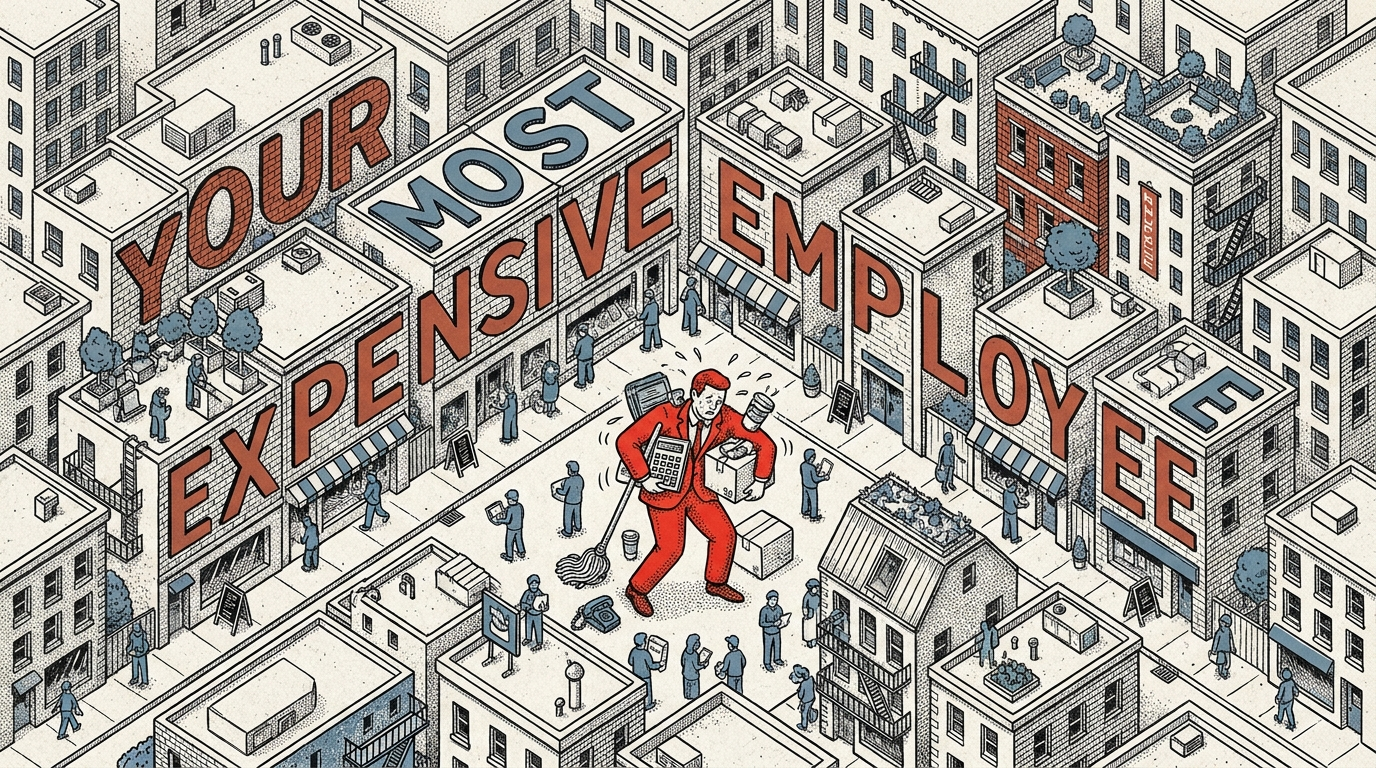
Your Most Expensive Employee
The owner who does everything isn't saving money. They're wasting it.
I know a guy who runs a cafe in Freo. Good operator. Opens at five, closes at three, does everything in between. He roasts his own beans. He does the books on Sunday nights. He runs the Instagram. He fixes the grinder when it jams. He even does the milk run when the delivery is late.
He told me once he hadn't taken a full week off in four years.
I asked him what he thought his time was worth. He said he didn't really think about it like that. He just did what needed doing.
So I did the maths for him. His cafe turns over about $600K. He works sixty hours a week, fifty weeks a year. That's three thousand hours. Divide the revenue by his hours and you get $200 an hour. That's what his time generates when he's doing the thing only he can do. Talking to customers. Thinking about the menu. Making decisions about the business.
But most of his week isn't that. Most of his week is doing things someone else could do for $30 an hour. Cleaning. Ordering stock. Posting on social media. Driving to the wholesaler because he forgot to add something to the order.
He's paying himself $200 an hour to do $30 work. And he's calling it dedication.
This is the trap almost every small business owner falls into. You start doing everything because you have to. You're the only one there. You can't afford help. Fair enough. But then the business grows and you keep doing everything because you've always done it. Because nobody does it quite like you. Because it's easier to just do it yourself than to explain it to someone else.
Except it isn't easier. It's more expensive. You just can't see the cost because it doesn't show up on a receipt.
Here's what I've learned about the businesses that actually scale. They don't have owners who work harder. They have owners who figured out which tasks they should never be doing.
He's paying himself $200 an hour to do $30 work. And he's calling it dedication.
There's a simple test for this. Look at your week and ask yourself one question about every task: could someone else do this to 80% of the standard I do it? If the answer is yes, you probably shouldn't be doing it.
Not 100%. Eighty percent. That's the part that trips people up. They want the person to do it exactly as well as they would. That's not the point. The point is to free up your $200 hours so you can spend them on the things that actually grow the business. The things nobody else can do.
The cafe owner in Freo. He was spending about fifteen hours a week on things that had nothing to do with growing his business. Fifteen hours at $200 an hour. That's $3,000 a week in opportunity cost. $156,000 a year.
He could have hired someone for $55K to do all of it. The gap between what he was losing and what it would cost to fix was over $100K.
When I showed him those numbers he went quiet for about thirty seconds. Then he said something that stuck with me. "I thought I was saving money by doing it myself."
That's the thing about this. It feels like you're being efficient. It feels like you're saving money. It feels like you're leading by example. But what you're actually doing is being the most expensive person in the building and using that expensive time on the cheapest tasks.
I've seen this pattern with dozens of wholesale accounts over the years. The ones that grow past a certain point always do the same thing. They stop. They look at their week. They figure out what they're doing that someone else could do. And they let go of it.
It's never comfortable. The first time you let someone else do the ordering, it'll come back wrong. The first time someone else runs the socials, the posts won't be as good. The first time someone else does the banking, you'll check it three times before you believe it's right.
That's normal. That's the cost of buying your time back. And it's a bargain compared to what you're paying now.
The businesses I respect most aren't run by people who do everything. They're run by people who know exactly which three or four things they should be doing, and they protect those hours like they're sacred. Everything else gets handed off, automated, or dropped entirely.
Think about it this way. If you're doing sixty hours a week and thirty of those hours could be done by someone else, you're not working sixty hours. You're working thirty hours on your business and spending thirty hours doing someone else's job. For free. Actually, worse than free. You're paying opportunity cost on every one of those hours.
The maths on hiring help is almost always better than people think. A part-time person at $25 an hour, twenty hours a week, costs you about $30K a year with super. If that frees up twenty hours of your week to spend on growth, partnerships, new accounts, improving the product, the return on that $30K is almost always five to ten times what you spent.
But it only works if you actually spend those freed-up hours on the high-value stuff. If you hire someone and then fill the time with more $30 tasks, you've just paid $30K to stay in exactly the same place.
The cafe owner in Freo. I saw him about six months later. He'd hired a part-time person. Three days a week. They did the ordering, the cleaning, the social media, the banking. He said the first month was brutal. Everything was slightly worse than when he did it himself.
By month three it was running smoother than it ever had. Because the new person wasn't also trying to run a cafe at the same time. They could actually focus on those tasks.
And him? He'd used the extra time to pitch three local offices on corporate catering. He landed two of them. Added about $40K in annual revenue.
From a $30K hire.
I asked him if he still felt guilty about not doing everything himself.
He laughed. "I feel guilty I didn't do it three years ago."
This week's move
Write down everything you did last week. Circle the tasks someone else could do at 80% of your standard. Pick one. Hand it off this month. Just one. See what happens when you get those hours back.
Get this in your inbox every Sunday.